What Is GEO? Generative Engine Optimization Guide for SEO Teams
GEO is a market term for improving visibility and citations in generated answers. Google explicitly treats optimization for its generative AI features as SEO, while other answer providers have their own retrieval and citation systems. The durable foundation is useful, original, crawlable content.
TL;DR
- For Google Search, GEO and AEO are still SEO: pages must be crawlable, indexed, snippet-eligible, relevant, and useful.
- There is no special Google AI schema, ideal answer-block length, or Google ranking benefit from llms.txt.
- Build non-commodity content with original evidence, first-hand expertise, clear sourcing, and a satisfying page experience.
- Use Search Console's generative AI report for Google visibility and separate grounded checks for supported non-Google providers.
What GEO means in plain English
Generative engine optimization is the practice of improving your website so AI search systems can use it as a source when they generate an answer. Those systems include Google AI Overviews, ChatGPT search experiences, Perplexity, Gemini, Claude-connected search products, and other answer engines that summarize the web instead of only listing links.
The term does not describe one universal ranking system. Google says its generative AI Search experiences use core Search ranking and quality systems, so ordinary SEO remains the route to eligibility. Other providers may use search crawlers, indexes, licensed sources, or grounding services. Optimize for people and verifiable usefulness first, then measure each surface honestly.
- A ranking is a position on a search results page.
- A citation is a source selected inside an answer.
- A mention is when the answer names your brand, product, or page.
- A GEO win happens when your content shapes the answer before the visitor reaches your site.
Why GEO matters even if SEO is already working
Organic traffic used to be easier to model. A person searched, scanned links, clicked a result, and evaluated the page. AI answers change the path. The answer may summarize the decision, compare options, name sources, and reduce the need for a click. A brand can still benefit from that moment, but only if it is named or cited.
That is why ranking alone is no longer a complete measure of visibility. If your page ranks for a valuable query but the AI answer cites a competitor, your search presence is weaker than the rank report suggests. The goal is not to abandon SEO. The goal is to use SEO data to find the pages most ready for a GEO lift.
The strongest starting point is usually not another generic article. Improve a page with proven demand by adding original evidence, first-hand detail, clearer sourcing, and a better experience.
The signals that make a page citation-ready
There is no public cross-engine recipe for earning a citation. The controllable work is familiar: make the page accessible, align it with the audience's need, contribute information that is not a commodity summary, support claims, and explain who created or reviewed the content.
Clear sections, tables, and definitions can help readers navigate when they genuinely suit the topic. They are presentation choices, not a required AI chunking formula. Structured data should describe visible content and support an established search feature, not manufacture authority the page does not have.
| Signal | What it means | How to improve it |
|---|---|---|
| Audience value | The page satisfies the need better than commodity summaries. | Add original analysis, first-hand experience, or proprietary evidence. |
| Entity clarity | The page names the brand, product, category, and use case consistently. | Use descriptive headings and schema where appropriate. |
| Evidence | Claims are supported by numbers, examples, steps, or comparisons. | Add tables, criteria, examples, and sourceable facts. |
| Crawlability | Search systems can fetch, render, and index the page. | Fix noindex, canonicals, status codes, internal links, and sitemap coverage. |
| Freshness | The page reflects the current market and query intent. | Refresh stale examples, dates, pricing notes, and product references. |
A practical GEO workflow from Search Console data
The mistake most teams make is starting GEO with a blank prompt list. That creates guesses. Search Console already tells you which queries people use, which pages Google associates with those queries, and where impressions exist without enough clicks. That data is the best starting point.
CiteWins turns that raw data into a prioritization layer. It looks for AI Overview gaps, striking-distance queries, low CTR pages, content decay, and cannibalization. Then it turns the signal into an action card with the exact content changes to make.
- 1
Sync the last 90 days of Google Search Console data.
- 2
Group query and page signals by opportunity type.
- 3
Prioritize pages that already have impressions and realistic upside.
- 4
Improve the page for visitors: strengthen intent coverage, original proof, sourcing, technical access, and internal links.
- 5
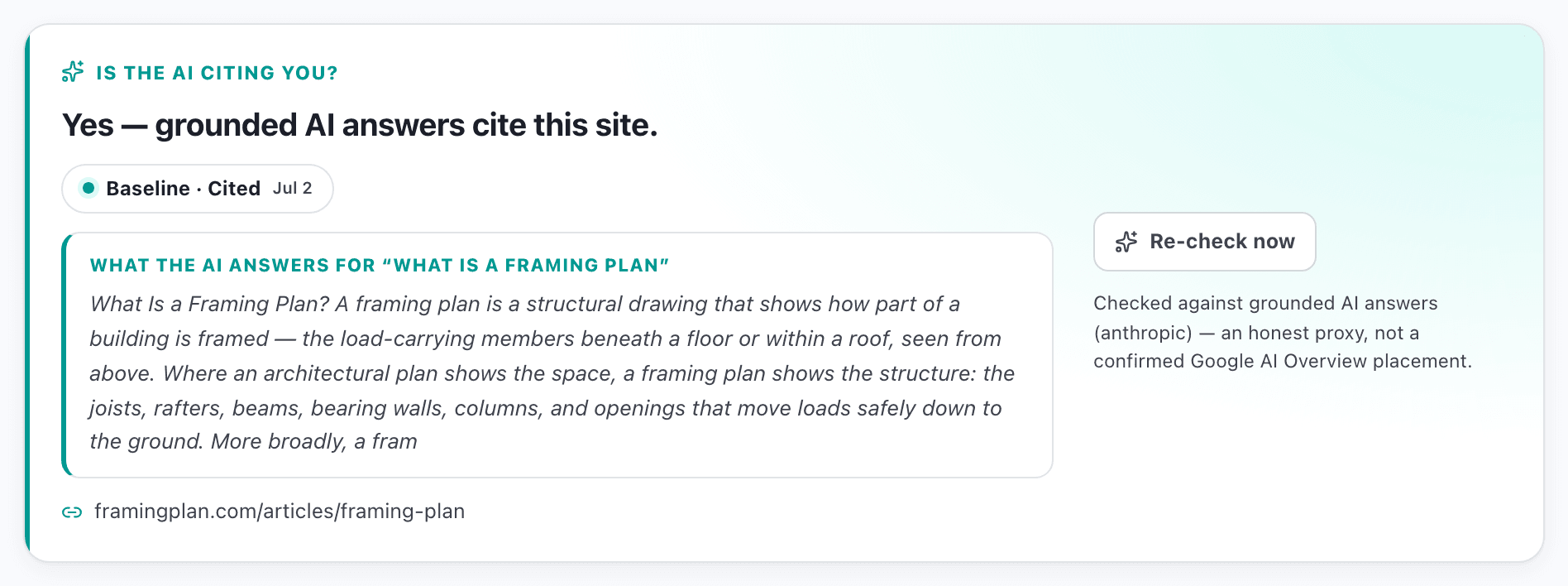
Track whether the page gains clicks, improves CTR, or starts getting cited by AI answers.
Common GEO mistakes to avoid
The most expensive mistake is treating GEO as a separate content calendar. If a page cannot be crawled, does not answer the query, or has weak authority, a GEO checklist will not rescue it. Start with the pages that already show search demand.
Another mistake is rewriting content only for AI systems. Google's guidance says no special AI writing style or chunking is required. Organize the page for readers, add material only when it improves the answer, and avoid creating near-duplicate pages for every prompt variation.
- Do not create isolated AI-search pages that are not internally linked.
- Do not stuff FAQ sections with questions the page does not properly answer.
- Do not rely on schema if the visible content is weak.
- Do not measure GEO only by sessions. Track citations, branded search lift, and assisted conversions too.
Primary sources
Official documentation used to review and update this guide.
Frequently Asked Questions
Is GEO the same as SEO?
For Google Search, Google says optimizing for generative AI is still SEO because AI Overviews and AI Mode use core Search ranking and quality systems. GEO is still useful as a broader workflow label when tracking citations and visibility across non-Google answer providers.
What is the fastest way to start GEO?
Start with pages that already have relevant demand. Confirm technical eligibility, then add original evidence, first-hand detail, accurate sourcing, and useful internal links where the page is weak. Measure Google visibility in Search Console and other providers with explicit citation checks.
Does GEO require a new tool?
You can start manually, but a tool helps prioritize which pages matter. CiteWins uses Search Console data to find the highest-upside fixes before you spend time rewriting content.