AI Overview Optimization: How to Become the Source Google Cites
Google says AI Overview optimization is SEO: create valuable, non-commodity content, keep the page crawlable and indexable, and provide a good experience. There is no special AI schema, ideal answer length, or llms.txt advantage in Google Search.
TL;DR
- Google's AI Overviews and AI Mode use core Search ranking and quality systems, so foundational SEO remains relevant.
- Unique, helpful, expert-led content is more durable than rewriting a commodity page into an AI-specific format.
- Use structured data when it matches visible content and an established Search feature; there is no special AI Overview schema.
- Use the generative AI performance report for Google impressions and the standard Performance report for query and click context.
What Google says AI Overview visibility depends on
A page must be indexed and eligible to appear in Google Search with a snippet before it can appear as a supporting source in Google's generative AI features. Crawling, canonicalization, internal links, technical accessibility, and a good page experience are still part of that foundation.
Content quality is the more important long-term differentiator. Google recommends unique viewpoints, first-hand expertise, and non-commodity information that visitors find satisfying. Organize the material clearly for readers, but do not chase a rigid AI-only writing formula.
- Index eligibility and permission to show a search snippet.
- Original analysis, first-hand experience, or evidence beyond common summaries.
- Important information available in crawlable text.
- Accurate business, product, or local details where relevant.
- A useful experience across devices with sensible internal links.
Page types that can add non-commodity value
Not every page should chase AI Overview visibility. Some pages exist to convert branded demand, support customers, or explain a product. Others are built for questions that AI systems are likely to summarize.
Comparison, definition, process, checklist, and troubleshooting pages can be valuable when they contain genuine expertise or evidence. The format alone does not earn visibility; a generic version that repeats the same advice as every other result remains commodity content.
| Page type | Why it works | Best improvement |
|---|---|---|
| Definition guide | AI answers need a clear explanation. | Add a short definition and examples. |
| Comparison page | Users ask which option is better. | Add criteria, pros, cons, and use cases. |
| Checklist | Steps are easy to extract. | Make each step specific and ordered. |
| Troubleshooting guide | Answers need causes and fixes. | Pair symptoms with actions. |
| Template | Users want something usable. | Show the template and explain when to use it. |
How to improve a section for visitors and Search
The fix is often smaller than teams expect. A full rewrite can help, but a page may instead need outdated claims corrected, missing first-hand detail added, sources made explicit, or an unclear section reorganized for readers.
A useful editorial pattern is answer, qualify, prove, and expand—but it is a writing aid, not a Google requirement. State the useful conclusion, explain when it applies, support it with evidence, and give interested visitors the depth needed to act.
- 1
Replace vague intros with a direct answer.
- 2
Add one sentence that defines the context or use case.
- 3
Add a short list or table of criteria.
- 4
Add schema only when the visible content supports it.
- 5
Link to related pages that prove topical coverage.
How to measure an AI Overview optimization
Measurement needs a before-and-after view. Where available, Search Console's generative AI performance report shows AI Overview and AI Mode impressions by page, date, country, and device. The standard Performance report provides query, click, CTR, and position context.
Do not expect every successful AI Overview fix to create immediate traffic. Sometimes the first win is being named as a source, followed by branded search, direct visits, or assisted conversions. That is why GEO measurement should sit next to SEO measurement, not replace it.
- Record the query, URL, and baseline search metrics.
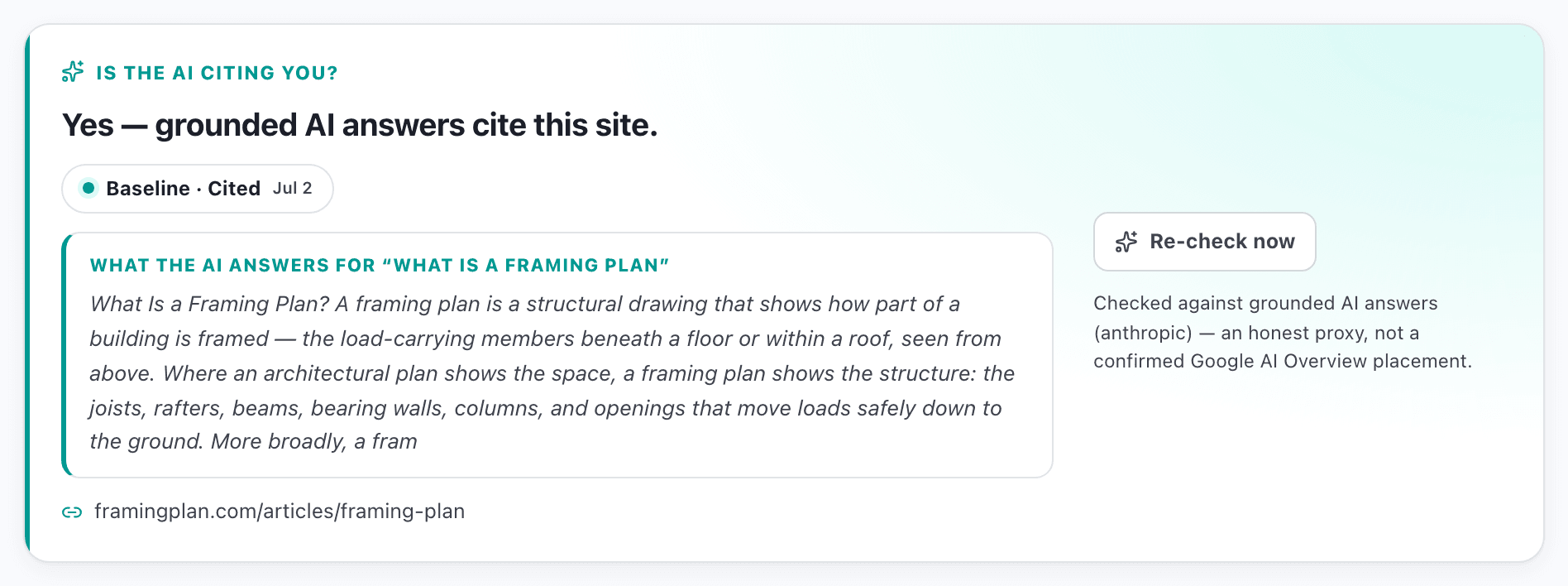
- Check whether the AI answer cites your page before the fix.
- Publish the rewrite and note the date.
- Wait long enough for recrawl and query volume.
- Compare clicks, CTR, position, and citation status.
Primary sources
Official documentation used to review and update this guide.
Frequently Asked Questions
Can I guarantee an AI Overview citation?
No. Meeting technical requirements and publishing excellent content does not guarantee crawling, indexing, or selection in an AI Overview. Google controls retrieval, ranking, and source presentation for each query.
Should every blog post have FAQ schema?
No. Add FAQ content when the page genuinely answers those questions. Schema should reflect visible, useful content rather than act as a shortcut.
What is the fastest AI Overview fix?
There is no universal shortcut. Start by correcting technical blockers and stale or commodity content. A focused improvement might add first-hand evidence, clearer sourcing, a more useful comparison, or missing context without rewriting the entire page.