AI Visibility Tracking: Metrics That Matter Beyond Organic Traffic
AI visibility is the measurement layer for GEO. It tells you whether your brand or page appears inside generated answers, not just whether someone clicked a blue link.
TL;DR
- Organic sessions alone do not capture AI-answer influence.
- Useful AI visibility metrics include citation status, mention rate, source share, sentiment, and assisted branded demand.
- Search Console remains important because it shows demand and performance on Google.
- CiteWins stores before-and-after citation checks on action cards so teams can prove wins.
What AI visibility means
AI visibility is how often your brand, website, or content appears in AI-generated answers for the questions your audience asks. It includes citations, named mentions, quoted passages, and sometimes the absence of competitors.
This matters because AI answers can influence the buyer before a click happens. A person might see your brand named in an answer, search for you later, or ask a follow-up question. Traditional analytics can miss that influence.
- Citation: the answer links to or names your page as a source.
- Mention: the answer names your brand or product.
- Share of answer: your presence compared with competitors.
- Sentiment: whether the answer frames you positively, neutrally, or negatively.
- Follow-up demand: branded searches and direct visits after answer exposure.
The metrics to track
A useful AI visibility dashboard should avoid vanity metrics. Counting every generated answer without tying it to a business query creates noise. Start with prompts that map to buyer questions, product categories, comparison decisions, and problem-aware searches.
Then connect AI visibility metrics to search metrics. If a page earns citations but not clicks, you may need stronger brand or conversion paths. If a page ranks but is not cited, you may need better answer structure.
| Metric | What it tells you | How to act |
|---|---|---|
| Citation status | Whether the page is used as a source. | Improve answer clarity and proof. |
| Mention rate | How often the brand appears. | Strengthen entity signals and third-party presence. |
| Competitor source share | Who owns the answer. | Study their cited passages and coverage gaps. |
| Sentiment | How the answer frames the brand. | Correct weak positioning and missing proof. |
| GSC CTR and clicks | Whether search behavior changed. | Rewrite titles, answers, and snippets. |
How to build an AI visibility workflow
Start small. Track the queries attached to your highest-value pages instead of trying to monitor every possible prompt. The goal is not a giant prompt database. The goal is to learn where the answer layer changes revenue-relevant discovery.
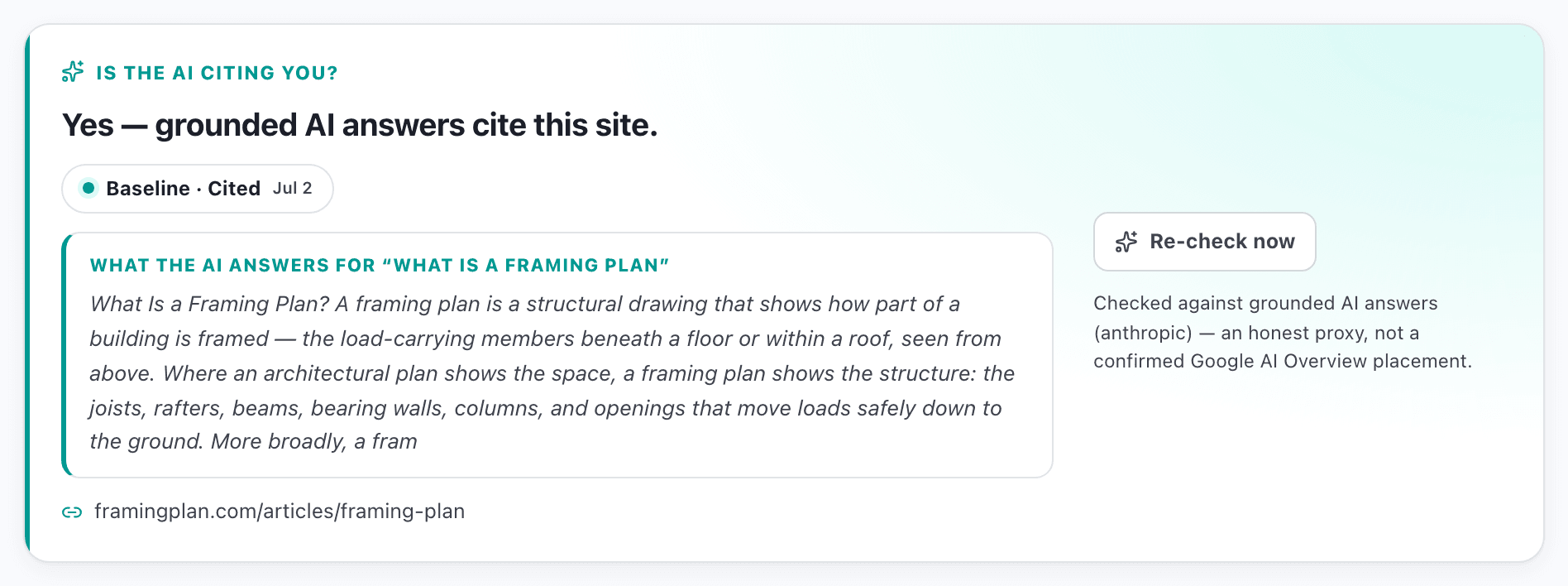
CiteWins ties citation checks to specific task cards. That keeps measurement connected to action: baseline the answer, ship the fix, re-check, and compare traffic.
- 1
Choose queries from Search Console or customer language.
- 2
Record whether the AI answer cites or mentions you before the fix.
- 3
Publish a targeted content improvement.
- 4
Re-check the answer after recrawl and model refresh cycles.
- 5
Compare citation status with GSC clicks, CTR, and position.
- 6
Turn wins into reports for stakeholders or clients.
Measurement mistakes that waste time
The biggest mistake is tracking prompts that no buyer would ask. The second is treating every AI engine as the same channel. Different systems can cite different sources for similar questions, so a single check should not become the whole strategy.
Another mistake is reporting AI visibility without a next step. A dashboard should produce decisions: which page to fix, which source to earn, which answer to monitor, and which win to show.
- Do not track prompts disconnected from customer intent.
- Do not measure only brand mentions and ignore source citations.
- Do not assume traffic will rise immediately after a citation.
- Do not separate AI checks from page-level SEO data.
- Do not report a problem without a recommended fix.
Frequently Asked Questions
Is AI visibility the same as organic traffic?
No. Organic traffic measures visits. AI visibility measures whether your brand or page appears inside AI-generated answers, even when a click does not happen.
Which prompts should I track first?
Start with buyer-intent queries, comparison questions, problem-aware searches, and Search Console queries tied to important pages.
Can AI visibility be reported to clients?
Yes. The clearest report shows baseline citation status, the shipped fix, follow-up citation status, and Search Console movement.